Why a Family Portrait Hits Different for a Milestone Birthday
A milestone birthday is not just another year. It is the kind of birthday where people stop and actually look back. Fifty years. Sixty years. Seventy. Mom is thinking about the people who matter most, and at the top of that list is almost always her family.
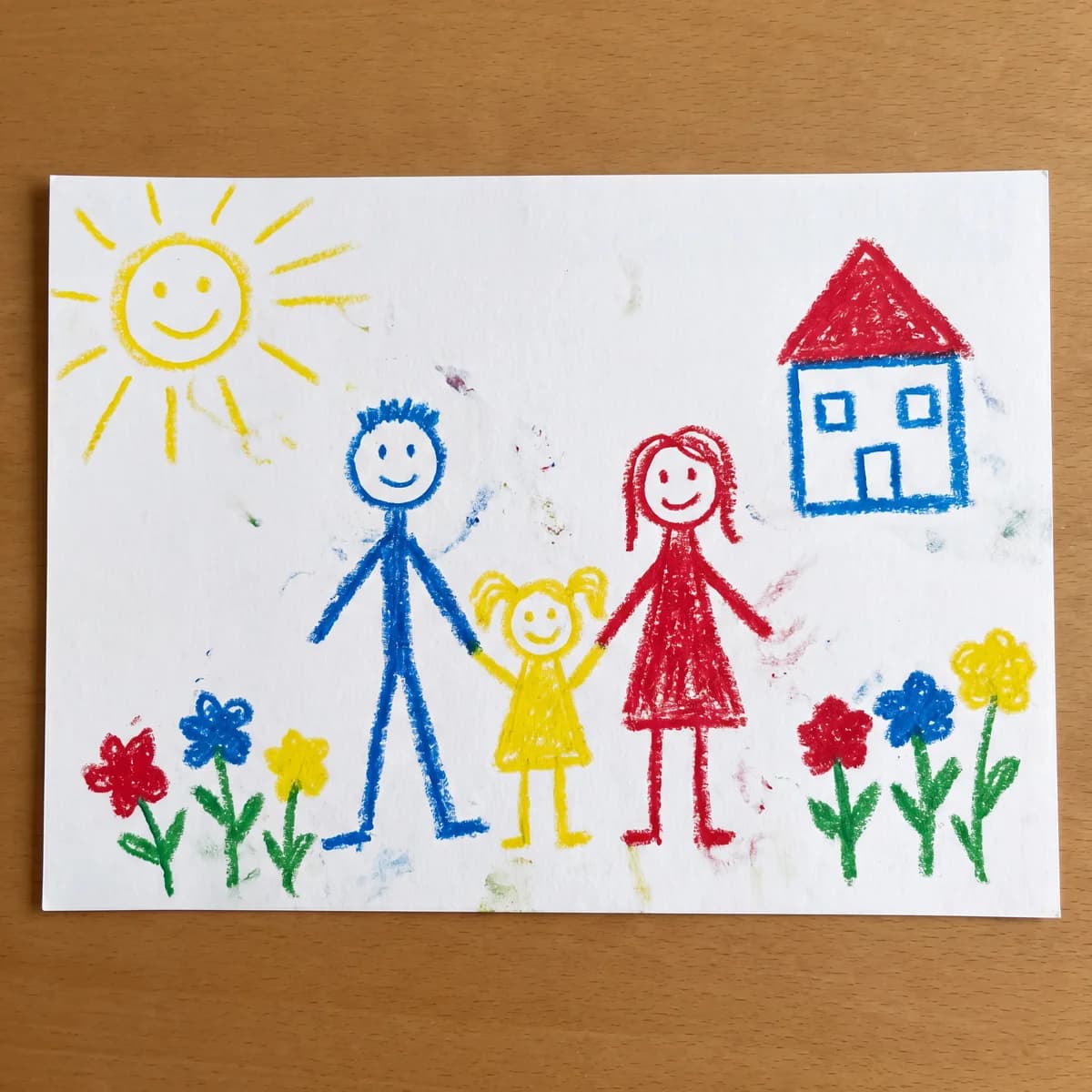
A kid's family portrait captures something no professional photo can. The proportions are wrong in the best way. Everybody is smiling. The house might be floating. The sun has a face. It is how a child sees the world, and more specifically, how a child sees Mom's world, and that is exactly what makes it the right image for this occasion.
When you pair that drawing with a birthday that carries real weight, you get a gift that does not feel purchased. It feels considered. It tells Mom that someone took the time to look at what her kid made and decided it deserved to be permanent.
What This Actually Is and How It Works
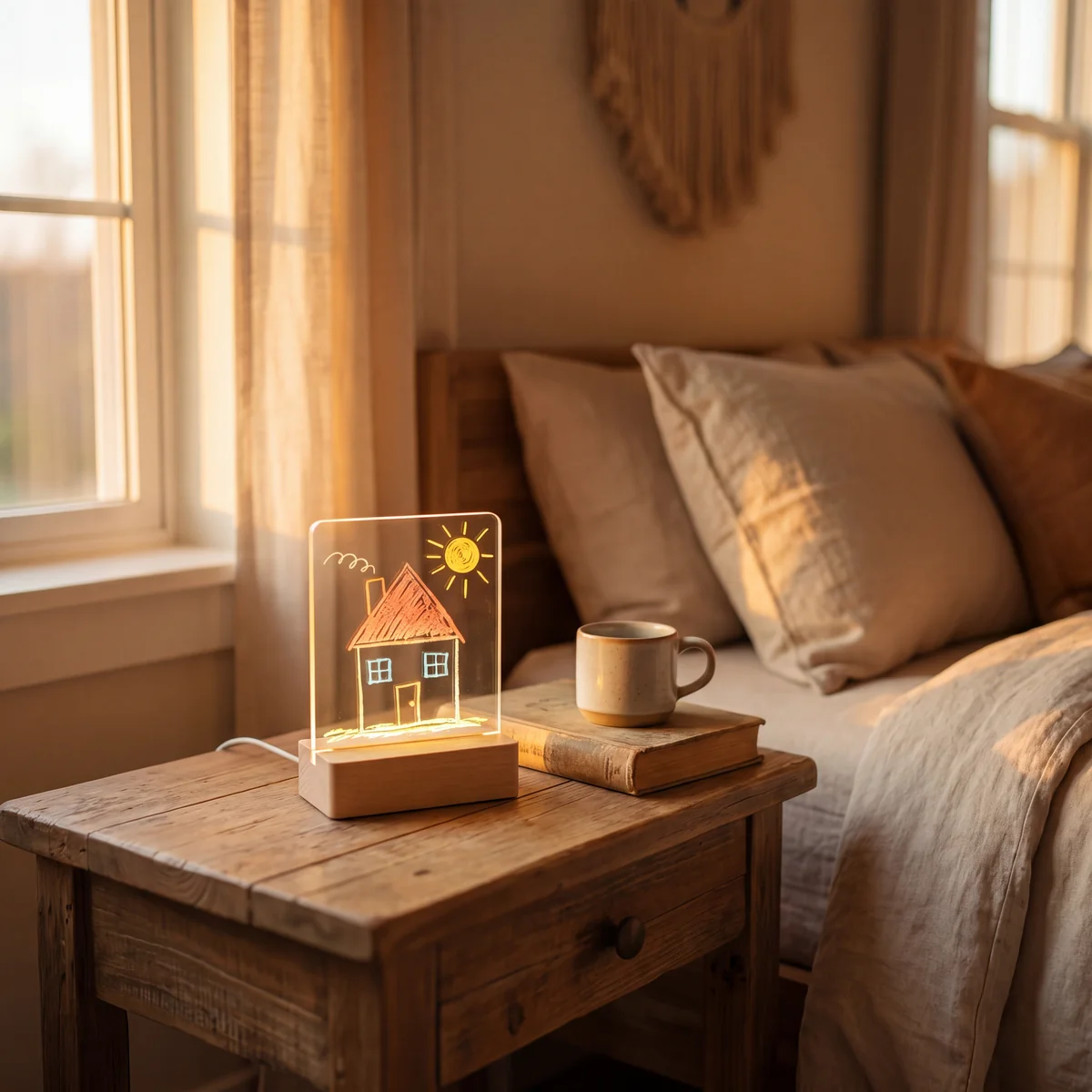
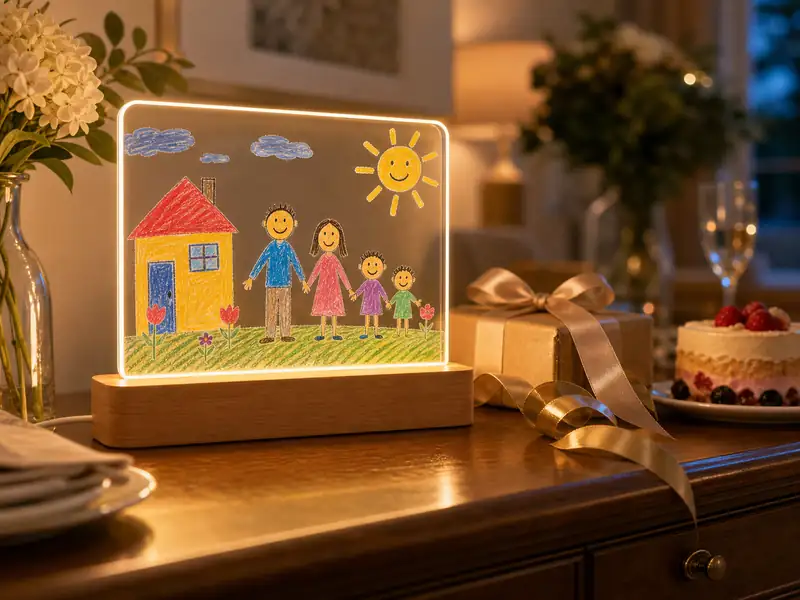
The night light is a laser-cut acrylic plaque, UV-printed directly with your child's drawing, mounted on a solid wood LED base. The base is warm-toned wood, roughly the size of a thick paperback, and it plugs in via USB. There is no complicated setup. You plug it in, the edge-lit acrylic glows, and the drawing lights up.
The UV printing process lays the image directly onto the acrylic surface. Colors stay accurate. Lines stay sharp. If your kid used crayon, marker, or pencil, those textures come through in the print. The acrylic itself acts as a light guide, so the glow comes from within the image rather than just behind it.
When the light is off, it reads as a printed acrylic plaque, clean and displayable on its own. When it is on, the drawing takes on a soft luminous quality that is genuinely pretty at night. Both states work. That matters if it is going on a desk or a shelf where people will see it during the day.
Tips for Getting the Most Out of a Family Portrait Drawing
Family portraits are one of the more complex drawing types we work with, and a few small things can make a meaningful difference in how the final light looks.
First, contrast helps. If the drawing was done on white paper with dark marker or crayon, it will translate cleanly. If it was done lightly in pencil, ask your kid to trace over the main lines before you scan or photograph it. You do not need to redraw anything. Just reinforce what is already there.
Second, lined paper is fine. A lot of people worry about this. Our team adjusts for lined-paper backgrounds during file prep, so the lines do not dominate the final print. If you have a choice, plain paper is slightly easier to work with, but do not let lined paper stop you from using the drawing you already have.
Third, scan rather than photograph if you can. A flatbed scan at 300 DPI or higher gives us a clean, flat image to work from. A photo taken in good natural light also works. What we want to avoid is heavy shadows or glare from a lamp directly above the drawing.